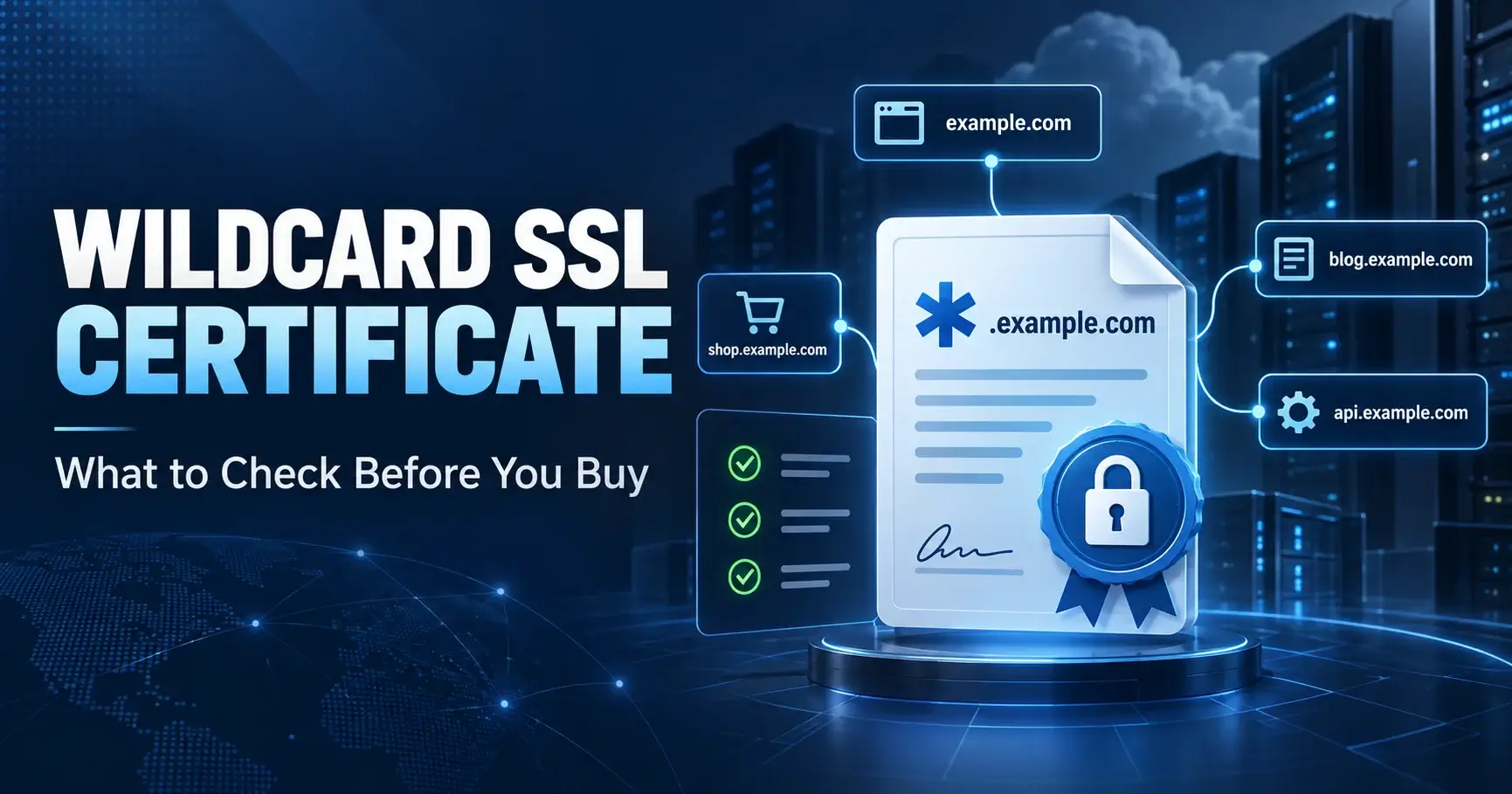
Wildcard SSL certificates are able to secure one main domain, as well as all its subdomains through a single certificate, which, in turn, upholds lower costs and demands less administration. Among the existing possibilities, the Sectigo Positive Wildcard SSL comes with rapid issuance, solid encryption, extensive browser compatibility, and a price that won’t strain the budget, thus proving to be a wise option for businesses, agencies, and developers who have to manage and maintain the still-expanding domain structures.
What Is a Wildcard SSL Certificate?
Wildcard SSL certificates are for those websites that have more than just a single hostname. A wildcard certificate, instead of giving separate certificates for every subdomain, encrypts them all under one umbrella of cryptographic protection.
Basically, a wildcard SSL certificate takes care of a domain and all of its first-level subdomains. So, the installation of the certificate will allow you to add new subdomains without needing to buy or install extra certificates.
The main features of wildcard SSL certificates are:
- One certificate covering an infinite number of subdomains at the first level
- Modern TLS protocols provide strong protection through encryption
- Easier management comes with a simplified certificate lifecycle
- Grow your website without worrying about the cost
These certificates find wide acceptance among SaaS providers, e-commerce sites, e-learning platforms, and companies with numerous functional subdomains that rely on them.
Wildcard SSL vs. Standard SSL
Standard SSL certificates are allotted to one fully qualified domain name only. If a business operates several subdomains, each one needs its own certificate, which increases the cost and complexity of the renewal process.
Wildcard SSL certificates provide a solution to this issue by unifying the coverage into one certificate.
Theoretical distinctions between the two:
- Coverage scope: standard SSL secures one hostname, while Wildcard SSL secures all subdomains.
- Management effort: Wildcard SSL causes to occur less frequently and is tracked less.
- Scalability: with Wildcard SSL, new subdomains can be added on-the-fly.
Both of them offer encrypted connections and browser trust from a security standpoint. The main benefit of Wildcard SSL certificates is their operational complexity, which, being simpler, is the main reason for long-term use.
Introducing Sectigo Positive Wildcard SSL
Sectigo Positive Wildcard SSL is the solution for organizations that want reliable encryption without premium-level complexity. It is issued by Sectigo, which is one of the most recognized authorities that has a global presence and is recognized the most. It therefore grants a vast browser and device trust.
This certificate relies on the domain validation method, which allows for a fast issuance process while still maintaining the encryption standard of the industry. It is aimed at public-facing websites, dashboards, and business platforms where speed and efficiency are critical.
What makes Sectigo’s Positive line so attractive is its affordability and reliability combination, particularly regarding businesses that are moving from single-domain SSL certificates to more advanced ones.
Key Features of Sectigo Wildcard SSL
The full Sectigo Positive Wildcard SSL’s feature package is up to par with modern hosting scenarios and ubiquitous usage of development processes.
The most important features are:
- Great encryption using state-of-the-art cipher support
- Compatibility with a variety of web servers, such as Apache, NGINX, IIS, and also with cloud platforms
- Speedy issuance via the validation of the domain
- One certificate covering an unlimited number of subdomains
- Recognized and trusted by all major operating systems’ browsers
The above features are helpful both for technical and administrative teams that run live websites.
Benefits for SMBs, Agencies, and Developers
Wildcard SSL certificates are not only a technical upgrade but also a workflow improvement.
For small and mid-sized businesses:
- The cost of certificates is decreased as the site expands
- Less frequent renewal dates to remember
- Uniform HTTPS for all services
For agencies:
- Management of multi-service platforms becomes easier
- The chance of missing renewals is lower
- Client portals have simplified security
For developers:
- Perfect HTTPS for staging, testing, and production
- Less configuration when adding subdomains
- Security that is the same across environments
This flexibility results in Sectigo Positive Wildcard SSL being particularly advantageous for quick-iterating teams.
Pricing, Licensing, and Renewal Options
Sectigo Positive Wildcard SSL is classified as a cheap wildcard solution. Its licensing model supports unlimited subdomains under a single domain, which eliminates the need for multiple certifications for domain extensions.
Often, the option of purchasing for several years is available, which can help organizations lower the cost and reduce the administrative burden of their long-term pricing plans. Domain revalidation is required for renewals; however, the procedure is usually quick and easy to anticipate.
For companies that expect to grow steadily, the pricing scheme is such that it is scalable with no unanticipated costs involved.
How to Install on Popular Hosting Platforms
The process of installing a wildcard SSL certificate is more or less the same everywhere and is typically standard across all hosting environments.
Typical installation flow:
- Create a CSR (Certificate Signing Request) from either the server or the control panel
- Carry out the domain validation as per the certificate authority’s direction
- Get the issued certificate and intermediate bundle downloaded
- Upload the certificate to the web server or load balancer
- Implement HTTPS on all subdomains
The majority of the modern hosting companies and control panels give you the option of guided installation tools, which makes the process easier and less prone to configuration errors.
Wildcard SSL Security Best Practices
Since the wildcard SSL certificate covers several subdomains, it is very important to handle security properly.
Following best practices is recommended:
- Protect the private key properly, and access to it should be allowed only to restricted users
- Use only the most recent versions of TLS and turn off all outdated protocols
- Adopt strong cipher suites equipped with the feature of forward secrecy
- Notify certificate expiry ahead of schedule
- Constantly check the configurations with SSL analysis tools
All of these measures will help to ensure that the use of wildcard certificates creates no problems or vulnerabilities, but rather works as a stronghold.
A guide to troubleshooting common issues
Though Wildcard SSL certificates are at times adopted, configuration challenges associated with them arise. The following are the common problems that cause such configuration issues:
- Mobile browsers give warning messages due to incomplete certificate chains
- Not interpreting the wildcard properly by assuming it applies to even deeper subdomains
- Overly strict securing company resources internally led to mixed content errors
The most common paths to trouble are confirming intermediate certificates, enforcing HTTPS, and, very critically, testing server setups.
Top Wildcard SSL Brands Compared
Sectigo Positive Wildcard SSL battles it out with DigiCert, GlobalSign, and GeoTrust. Premium brands usually highlight the fact that they do high validation and provide extended warranties, while Sectigo emphasizes the other two dimensions – affordability and quick implementation.
On the other hand, if the organization’s main priority was customer control, compatibility, and ease of use, then Sectigo could still be considered as one of the best wildcard SSL certificates.
Feedback from Customers and Case Studies
A considerable number of companies depend on the Sectigo Positive Wildcard SSL for securing their customer portals, regional websites, and application dashboards. Agencies often make use of it in cases where the platform is set up for constantly creating new subdomains.
Developers identify this as being the reason to avoid going back and forth between development and production, thus being able to contain friction during deployment and testing.
Expert Recommendations & SEO Implications of HTTPS
Besides, HTTPS is already part of the baseline trust requirement for search engines. Noteworthy is that SSL alone does not give the site a higher ranking, but the unsecured pages can get browser warnings that can cut down on user engagement and the site’s credibility.
There is a consensus among experts that wildcard SSL certificates are to be used by large sites to avoid migrations and configuration changes constantly. Besides, the communication of trust between users and sites is made easier by the consistent use of the HTTPS protocol across all the subdomains, thus allowing smooth crawling, indexing, and user trust.
Conclusion
Wildcard SSL certificates offer a great option for securing modern multi-domain websites that are high in demand and low in user interaction. They take away the hassle of dealing with multiple certificates, save money, and encrypt all traffic uniformly.
Sectigo Positive Wildcard SSL carries the hallmark of a rational solution for companies that rely on the working of the certificate but do not want to have extra problems and costs. It is a solution that suits the businesses that want to rebuild trust and become stable slowly but surely, with the bonus of HTTPS protection for the long run.
FAQs
1. What are the benefits of using wildcard SSL certificates?
Among their benefits, one can count the security of a primary domain and all other first-level subdomains through a single certificate. This not only decreases expenses but also simplifies SSL management as the websites grow.
2. Is Sectigo Positive Wildcard SSL recognized by browsers?
Indeed, Sectigo Positive Wildcard SSL is acknowledged by all major web browsers and operating systems. It grants the standard encryption and shows secure markers that are acknowledged worldwide.
3. Are wildcard SSL certificates beneficial for SEO?
A wildcard SSL certificate activates HTTPS for all subdomains, thus eliminating the browser warnings and therefore keeping the user’s trust. Despite the fact that SSL is not a direct ranking factor, it is a significant contributor to increased user engagement and crawl stability.
4. Are wildcard SSL certificates compatible with cloud hosting services?
Absolutely, wildcard SSL certificates could be used in almost all cloud hosting platforms, VPSs, and even up to the traditional hosting setup. They apply to all SSL-compatible servers, load balancers, and CDNs.