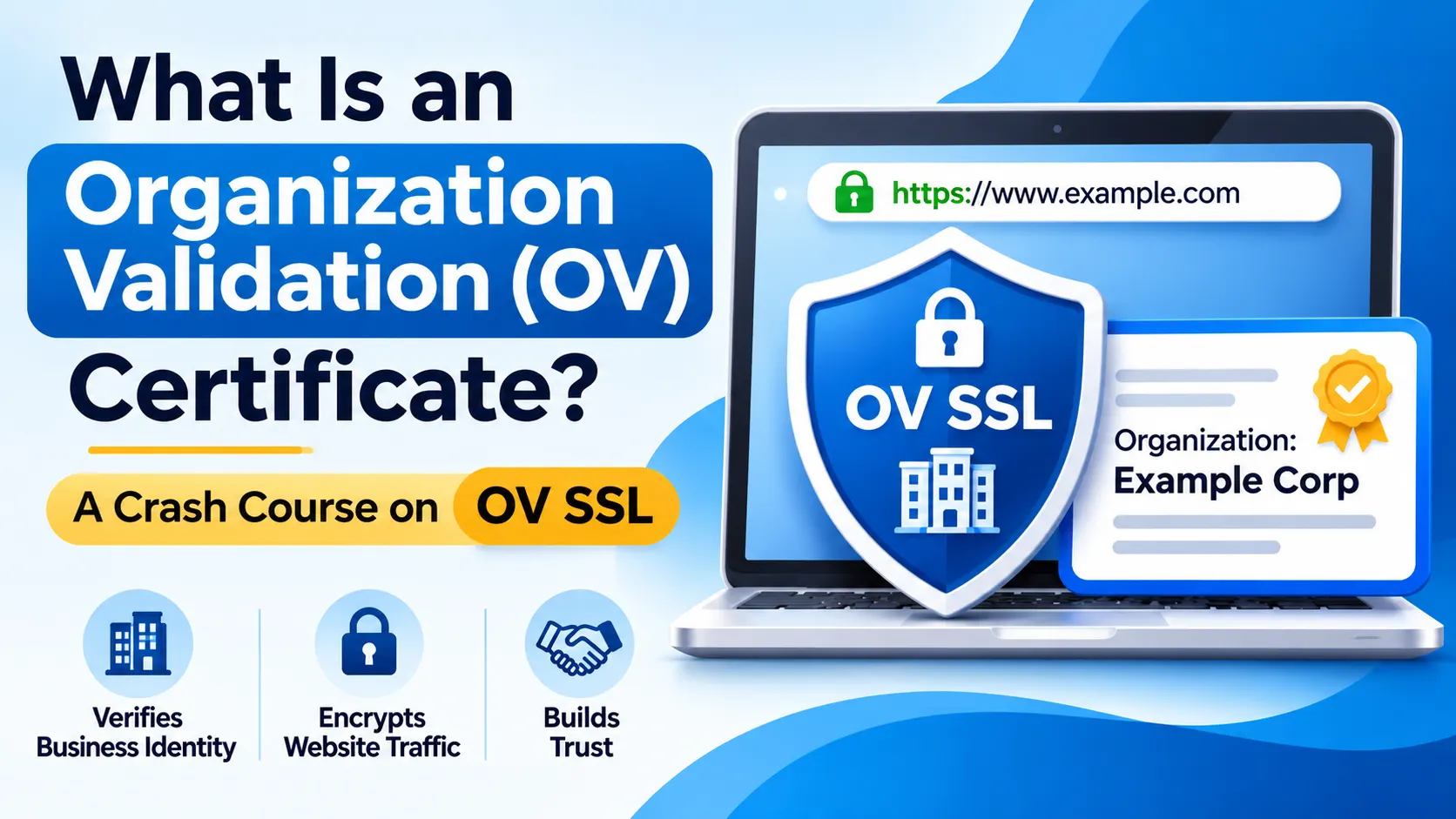
An OV certificate encrypts traffic like any SSL certificate. It also tells anyone who checks which registered business runs the site.
An Organization Validation (OV) Certificate is an SSL/TLS certificate that a certificate authority (CA) issues only after confirming two things: that you control the domain, and that your organization legally exists at the location you stated. The verified company name is written into the certificate itself, so anyone who inspects it can see who operates the site.
The second check is why OV exists. Encryption is the same across every certificate type. The difference is how much the CA knew about you before it signed.
SSL (Secure Socket Layer) in 60 seconds
SSL stands for Secure Sockets Layer, the protocol that first encrypted traffic between browsers and web servers. It was retired years ago in favor of Transport Layer Security (TLS), and TLS 1.2 and 1.3 do the work today. Nobody stopped saying “SSL certificate,” though, so the term still means the certificate your server presents when a browser connects.
A certificate carries your server’s public key, which the browser uses to set up an encrypted session. It also carries a CA’s signature vouching for whose key it is. How much the CA checked before signing is called the validation level. There are three.
OV vs DV vs EV at a glance
| Domain Validation (DV) | Organization Validation (OV) | Extended Validation (EV) | |
| What the CA checks | Domain control only | Domain control + organization identity | Domain control + stricter organization vetting |
| Company name in certificate | No | Yes | Yes |
| Typical issuance | Minutes | 1–3 business days | Several business days |
| What visitors see | Padlock | Padlock; company name in certificate details | Padlock; company name in certificate details |
| Best suited to | Blogs, personal and brochure sites | Business sites, login portals, B2B and partner-facing services | Organizations with policy or procurement requirements for EV |
What the CA verifies for an OV certificate
Every CA runs its own version of this checklist. Sectigo’s documented process is a fair example of what to expect.
- The CA confirms your business is registered and active with the relevant government registry, and that the registry details match your order. Any trade name you use has to be current as well.
- It checks that you have a physical presence in the registered city, state or country.
- It looks for your phone number in an acceptable public directory, listed under the same business name.
- You prove domain control by replying to an approval email sent to a standard admin address, uploading a file to the site, or adding a DNS record.
- Finally, someone from the CA calls that verified number to confirm the order. The call rarely takes more than a few minutes.
When registry or directory listings don’t line up, CAs will accept supporting evidence such as a Dun & Bradstreet report or a legal opinion letter from a licensed attorney or accountant. In our experience, almost every OV delay comes down to one thing: the company name or address on the order doesn’t match the registry exactly. Check that first. Renewals are usually quicker, because CAs can reuse validated organization details for a limited period.
What an OV Certificate Looks like
Open the certificate’s subject field and the difference is obvious. Here is a DV certificate:
$ openssl x509 -in dv.crt -noout -subject
subject=CN = www.example.com
And here is an OV certificate for the same domain:
$ openssl x509 -in ov.crt -noout -subject
subject=C = US, ST = Texas, L = Austin, O = Example Corp, CN = www.example.com
The O field holds the verified organization name. A DV certificate can’t carry it, because nobody checked.
When an OV certificate is Worth it
We’d recommend OV if people log in to your site or pay you through it. A verified name gives a careful user a way to tell your business apart from a look-alike domain.
It also helps when you sell to other businesses. Vendor security questionnaires regularly ask what validation level your certificates use, and “OV” is an easier answer than explaining why you chose DV. The same goes for APIs that partners integrate with, since their engineers sometimes inspect your certificate and want to see who runs the endpoint. And some internal standards and compliance frameworks simply require organization-validated certificates for public services.
If you run a blog or a simple brochure site, a DV certificate is fine, and we’d say that even though we sell OV. A free certificate from Let’s Encrypt encrypts traffic exactly as well as a paid one. You pay for OV to get identity assurance. You don’t get stronger encryption.
Common Misconceptions About OV Certificates
“OV encrypts better than DV.” It doesn’t. Key sizes and algorithms are identical. Only the identity checks differ.
“Visitors will see my company name in the address bar.” Modern browsers don’t show it there. The name appears when someone opens the certificate details.
“A padlock means the site is safe.” A padlock means the connection is encrypted. OV adds that the operator was verified, but a compromised site with a valid certificate can still serve malware.
“I’ll install it and forget about it for years.” That stopped being possible some time ago. Under CA/Browser Forum Ballot SC-081, the maximum validity for public TLS certificates dropped to 200 days on March 15, 2026. It falls to 100 days on March 15, 2027, and to 47 days on March 15, 2029. If you aren’t automating renewals yet, this is the year to start.
FAQ
How long does an OV certificate take to issue?
Usually one to three business days, provided your registry, directory and order details match.
Is an OV certificate available as a wildcard or multi-domain certificate?
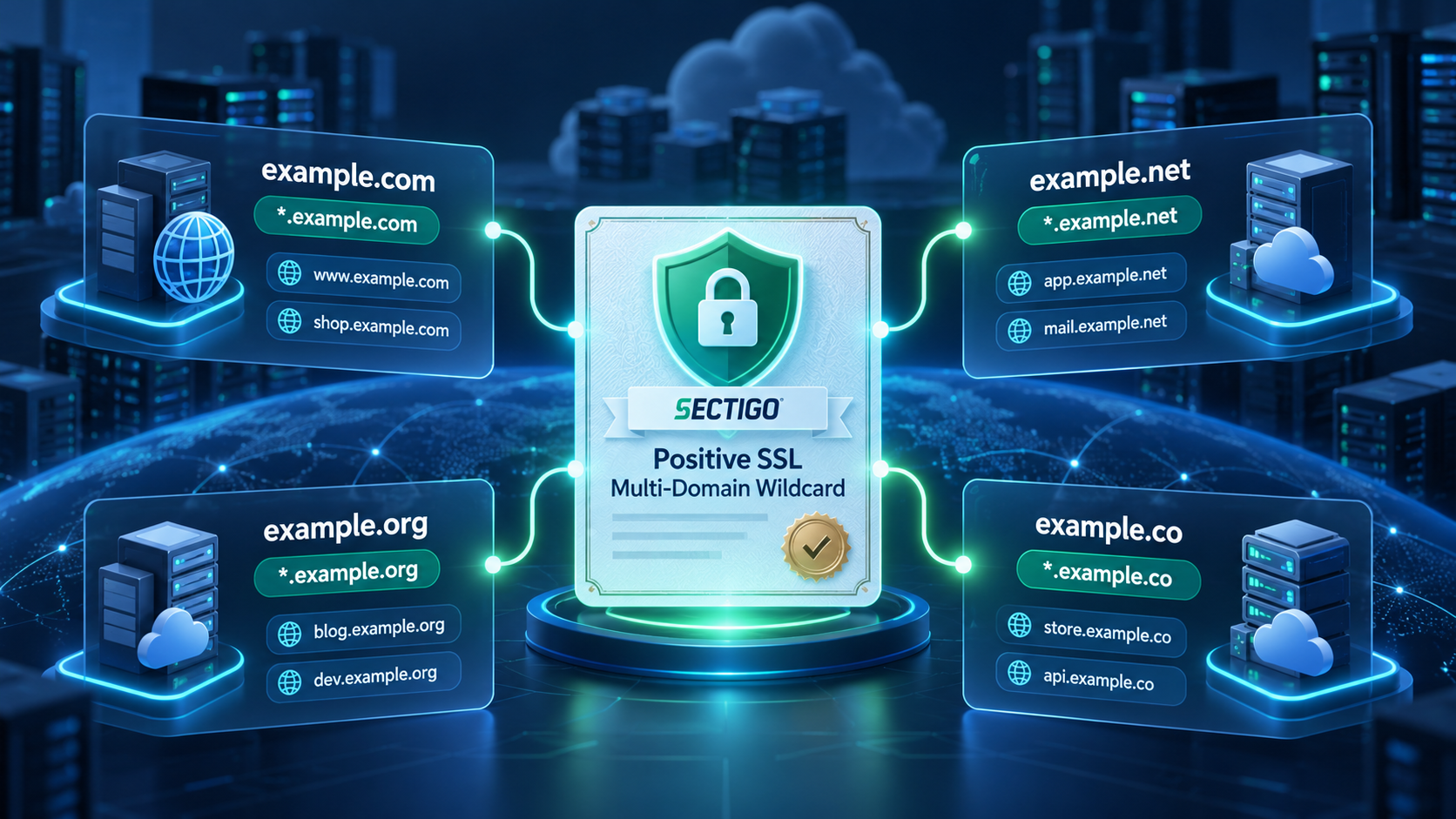
Generally yes. Most CAs sell OV in single-domain, wildcard and multi-domain versions. Check the product for how many names it covers.
Is SSL still used?
The SSL protocol isn’t. Every modern connection uses TLS, and “SSL certificate” survives as the everyday name for a TLS certificate.